Το έγγραφο που διέρρευσε σε σουηδική εφημερίδα θέλει τις ΗΠΑ να προετοίμασαν τον πόλεμο στην Ουκρανία για να πλήξουν την ΕΕ! Είναι αυθεντικό;

Το έγγραφο που διέρρευσε σε σουηδική εφημερίδα θέλει τις ΗΠΑ να προετοίμασαν τον πόλεμο στην Ουκρανία για να πλήξουν την ΕΕ! - Είναι αυθεντικό;
Ποια είναι η Rand Corporation:
Η RAND Corporation ("έρευνα και ανάπτυξη") [7] είναι μια αμερικανική μη κερδοσκοπική ομάδα σκέψης παγκόσμιας πολιτικής [1] που δημιουργήθηκε το 1948 από την Douglas Aircraft Company για να προσφέρει έρευνα και ανάλυση στις Ένοπλες Δυνάμεις των Ηνωμένων Πολιτειών
Πότε απασχόλησε ξανά τον διεθνή τύπο;
Ο Daniel Ellsberg (γεννημένος στις 7 Απριλίου 1931) είναι Αμερικανός πολιτικός ακτιβιστής και πρώην στρατιωτικός αναλυτής των Ηνωμένων Πολιτειών . Ενώ εργαζόταν στην RAND Corporation , ο Ellsberg προκάλεσε μια εθνική πολιτική διαμάχη το 1971 όταν κυκλοφόρησε τα Pentagon Papers , μια άκρως απόρρητη μελέτη του Πενταγώνου για τη λήψη αποφάσεων της κυβέρνησης των ΗΠΑ σε σχέση με τον πόλεμο του Βιετνάμ , στους The New York Times , The Washington Post και άλλες εφημερίδες.
Στις 3 Ιανουαρίου 1973, ο Έλσμπεργκ κατηγορήθηκε βάσει του νόμου περί κατασκοπείας του 1917 μαζί με άλλες κατηγορίες για κλοπή και συνωμοσία, με συνολική μέγιστη ποινή κάθειρξης 115 ετών. Λόγω κυβερνητικού παραπτώματος και παράνομης συλλογής αποδεικτικών στοιχείων και της υπεράσπισης του Leonard Boudin και του καθηγητή της Νομικής Σχολής του Χάρβαρντ, Charles Nesson , ο δικαστής William Matthew Byrne Jr. απέρριψε όλες τις κατηγορίες εναντίον του Ellsberg στις 11 Μαΐου 1973.
Ο Έλσμπεργκ τιμήθηκε με το βραβείο Right Livelihood το 2006. Είναι επίσης γνωστός για τη διατύπωση ενός σημαντικού παραδείγματος στη θεωρία αποφάσεων , το παράδοξο του Έλσμπεργκ , τις εκτενείς μελέτες του για τα πυρηνικά όπλα και την πυρηνική πολιτική και για την υποστήριξη των WikiLeaks , Chelsea Manning και Έντουαρντ Σνόουντεν .
Ο Έλσμπεργκ τιμήθηκε με το Βραβείο Όλοφ Πάλμε 2018 για τον «βαθύ ανθρωπισμό και το εξαιρετικό ηθικό του θάρρος». [1]
Τι λέει εν συντομία το κείμενο;
Ότι η χρηματοπιστωτική κρίση στις ΗΠΑ μπορεί να λυθεί μόνο αν διαλύσει οικονομικά την Ευρώπη, χτυπώντας την κεντρική της δύναμη όπου είναι η Γερμανία. Αυτό φυσικά θα επιφέρει την κατάρρευση όλων εξαρτώμενων χωρών από την Ευρωπαϊκή Κεντρική Τράπεζα.
Το κείμενο:
Research Report
January 25, 2022 Confidential
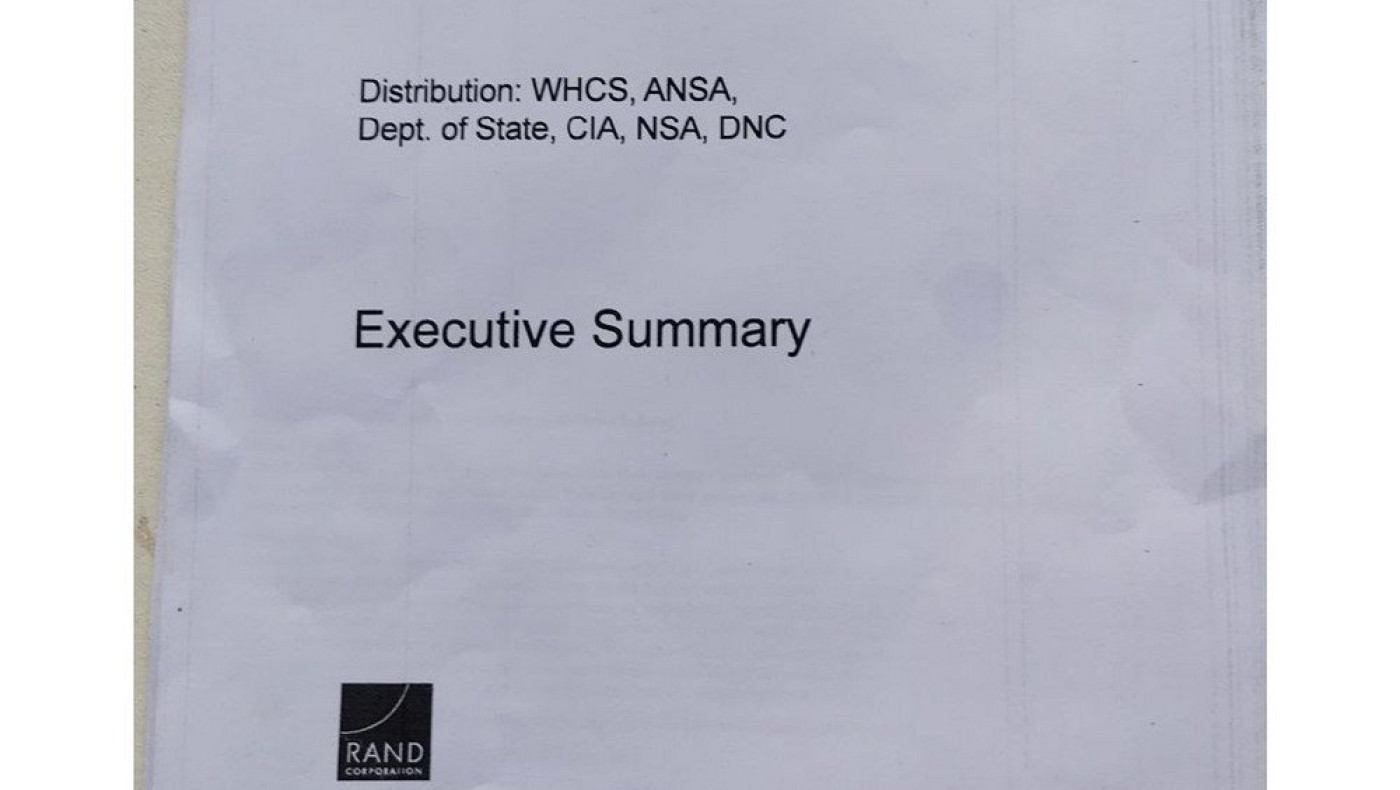
Distribution: WHCS, ANSA, Dept, of State, CIA, NSA, DNC
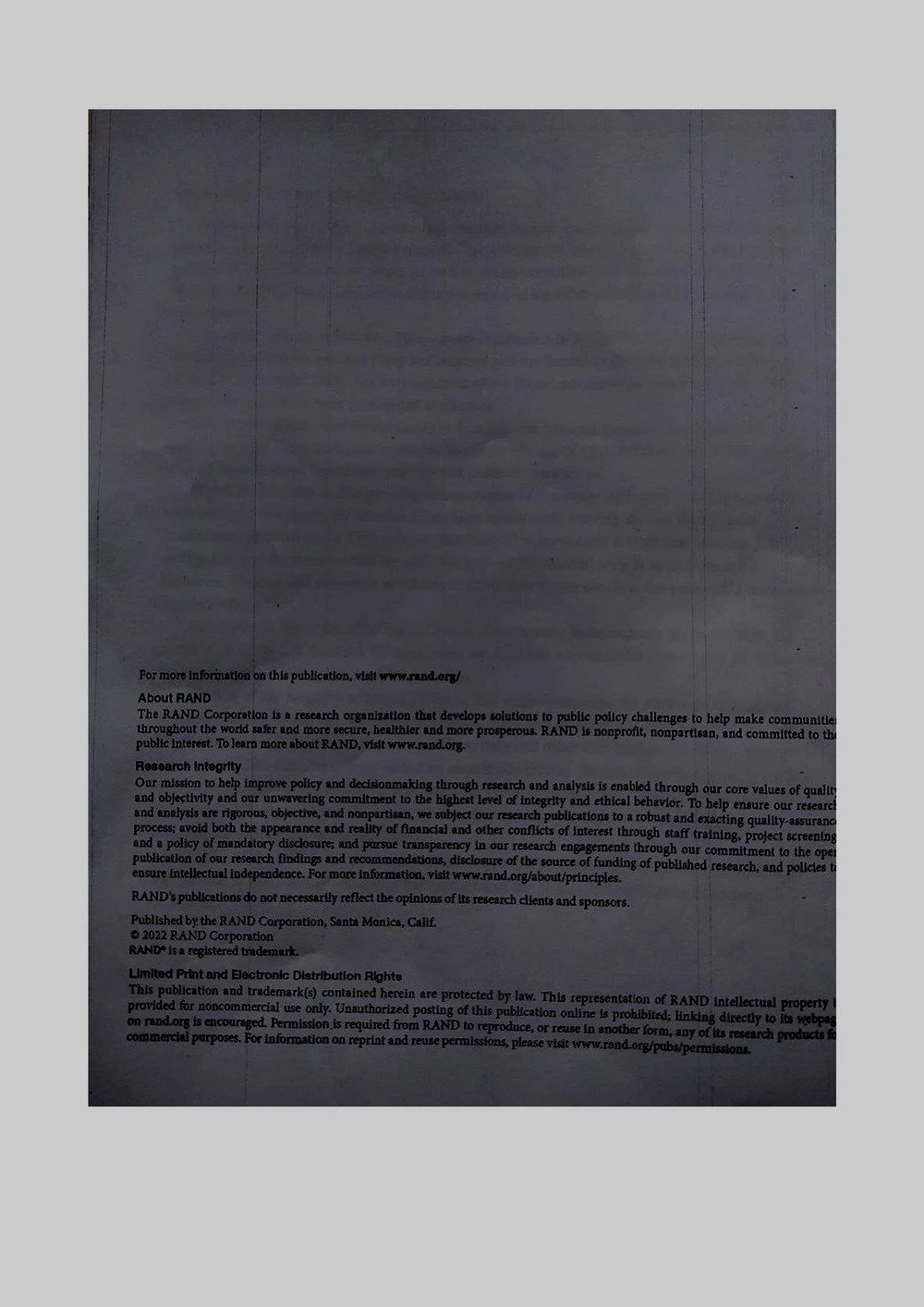
For more information on this publication, visit www.rand.org/
About RAND
The RAND Corporation is a research organization that develops solutions to public policy challenges to help make communitie: throughout the world safer and more secure, healthier and more prosperous. RAND is nonprofit, nonpartisan, and committed to th< public interest. To learn more about RAND, visit www.rand.org.
Research Integrity
Our mission to help improve policy and decisionmaking through research and analysis is enabled through our core values of quality and objectivity and our unwavering commitment to the highest level of integrity and ethical behavior. To help ensure our researcl and analysis are rigorous, objective, and nonpartisan, we subject our research publications to a robust and exacting quality-assuranci process; avoid both the appearance and reality of financial and other conflicts of interest through staff training, project screening and a policy of mandatory disclosure; and pursue transparency in our research engagements through our commitment to the ope publication of our research findings and recommendations, disclosure of the source of funding of published research, and policies t ensure intellectual independence. For more information, visit www.rand.org/about/principles.
RAND’s publications do not necessarily reflect the opinions of its research clients and sponsors.
Published by the RAND Corporation, Santa Monica, Calif.
$ 2022 RAND Corporation
RAND* is a registered trademark.
Limited Print and Electronic Distribution Rights
This publication and trademark(s) contained herein are protected by law. This representation of RAND intellectual property provided tbr noncommercial use only. Unauthorized posting of this publication online is prohibited; linking directly to its webpag on rand.org is encouraged. Permission is required from RAND to reproduce, or reuse in another form, any of its research products fc commercial purposes. For information on reprint and reuse permissions, please visit www.rand.org/pubs/permissions.
Weakening Germany, strengthening the U.S.
The present state of the U.S. economy does not suggest that it can function without financial and material support from external sources. The quantitative easing policy, which the Fed has resorted to regularly in recent years, as well as the uncontrolled issue of cash during the 2020 and 2021 Covid lockdowns, have led to a sharp increase in the external debt and an increase in the dollar supply.
The continuing deterioration of the economic situation is highly likely to lead to a loss in the position of the Democratic Party in Congress and the Senate in the forthcoming elections to be held in November 2022. The impeachment of the President cannot be ruled out under these circumstances, which must be avoided at all costs.
There is an urgent need for resources to flow into the national economy, especially the banking system. Only European countries bound by EU and NATO commitments will be able to provide them without significant military and political costs for us.
The major obstacle to it is growing independence of Germany. Although it still is a country with limited sovereignty, for decades it has been consistently moving toward lifting these limitations and becoming a fully independent state. This movement is slow and cautious, but steady. Extrapolation shows that the ultimate goal can be reached only in several decades. However, if social and economic problems in the United States escalate, the pace could accelerate significantly.
An additional factor contributing to Germany’s economic independence is Brexit. With the withdrawal of the UK from the EU structures, we have lost a meaningful opportunity to influence the negotiation of crossgovemmental decisions.
It is fear of our negative response which by and large determines the relatively slow speed of those changes. If one day we abandon Europe, there will be a good chance for Germany and France to get to a full political consensus. Then, Italy and other Old Europe countries - primarily the former ECSC members - may join it on certain conditions. Britain, which is currently outside the European Union, will not be able to resist the pressure of the Franco-German duo alone. If implemented, this scenario will eventually turn Europe into not only an economic, but also a political competitor to the United States.
Besides, if the U.S. is for a certain period is engulfed by domestic problems, the Old Europe will be able to more effectively resist the influence of the U.S.-oriented Eastern European countries.
Vulnerabilities in German and EU Economy
! An increase in the flow of resources from Europe to U.S. can be expected if Germany begins
to experience a controlled economic crisis. The pace of economic development in the EU depends almost without alternative on the state of the German economy. It is Germany that bears the brunt of the expenditure directed towards the poorer EU members.
The current German economic model is based on two pillars. These are unlimited access to cheap Russian energy resources and to cheap French electric power, thanks to the operation of nuclear power plants. The importance of the first factor is considerably higher. Halting Russian supplies can well create a systemic crisis that would be devastating for the German economy and, indirectly, for the entire European Union.
The French energy sector could also soon begin to experience heavy problems. The predictable stop of Russian-controlled nuclear fuel supplies, combined with the unstable situation in the Sahel region, would make French energy sector critically dependent on Australian and Canadian fuel. In connection with the establishment of AUKUS, it creates new opportunities to exercise pressure. However this issue is beyond the scope of the present report.
A Controlled Crisis
Due to coalition constraints, the German leadership is not in full control of the situation in the country. Thanks to our precise actions, it has been possible to block the. commissioning of the Nord Stream 2 pipeline, despite the opposition of lobbyists from the steel and chemical industries. However, the dramatic deterioration of the living standards may encourage the leadership to reconsider its policy and return to the idea of European sovereignty and strategic autonomy.
The only feasible way to guarantee Germany’s rejection of Russian energy supplies is to involve both sides in the military conflict in Ukraine. Our further actions in this country will inevitably lead to a military response from Russia. Russians will obviously not be able to leave unanswered the massive Ukrainian army pressure on the unrecognized Donbas republics. That would make possible to declare Russia an aggressor and apply to it the entire package of sanctions prepared beforehand.
Putin may in turn decide to impose limited counter-sanctions - primarily on Russian energy supplies to Europe. Thus, the damage to the EU countries will be quite comparable to the one to the Russians, and in some countries - primarily in Germany - it will be higher.
The prerequisite for Germany to fall into this trap is the leading role of green parties and ideology in Europe. The German Greens are a strongly dogmatic, if not zealous, movement, which makes it quite easy to make them ignore economic arguments. In this respect, the German Greens somewhat exceed their counterparts in the rest of Europe. Personal features and the lack of professionalism of their leaders - primarily Annalena Baerbock and Robert Habeck - permit to presume that it is next to impossible for them to admit their own mistakes in a timely manner.
Thus, it will be enough to quickly form the media image of Putin’s aggressive war to turn the Greens mto ardent and hardline supporters of sanctions, a ‘party of war’. It will enable the sanctions regime to be introduced without any obstacles. The lack of professionalism of the current leaders will not allow a .setback in the future, even when the negative impact of the chosen policy becomes obvious enough. The partners in the German governing coalition will simply have to follow their allies - at least until the load of economic problems outweighs the fear of provoking a government crisis.
However, even when the SPD and the FDP are ready to go against the Greens, the possibility for the next government to return relations with Russia to normal soon enough will be noticeably limited. Germany’s involvement in large supplies of weapons and military equipment to the Ukrainian army will inevitably generate a strong mistrust in Russia, which will make the negotiation process quite lengthy.
If war crimes and Russian aggression against Ukraine are confirmed, the German political leadership will not be able to overcome its EU partners’ veto on assistance to Ukraine and reinforced sanctions packages. This will ensure a sufficiently long gap in cooperation between Germany and Russia, which will make large German economic operators uncompetitive.
Expected Consequences
A reduction in Russian energy supplies - ideally, a complete halt of such supplies - would lead to disastrous outcomes for German industry. The need to divert significant amounts of Russian gas for winter heating of residential and public facilities will further exacerbate the shortages. Lockdowns in industrial enterprises will cause shortages of components and spare parts for manufacturing, a breakdown of logistic chains, and, eventually, a dominc effect. A complete standstill at the largest in the chemical, metallurgical, and machine-building, plants is likely, while they have virtually no spare capacity to reduce energy consumption. It could lead to the shutting down of continuous-cycle enterprises, which would mean their destruction.
The cumulative losses of the German economy can be estimated only approximately. Even if the restriction of Russian supplies is limited to 2022, its consequences will last for several years, and the total losses could reach 200-300 billion euros. Not only will it deliver a devastating blow to the German economy, but the entire EU economy will inevitably collapse. We are talking not about a decline in economy growth pace, but about a sustained recession and a decline in GDP only in material production by 3-4% per year for the next 5-6 years. Such a fall will inevitably cause panic in the financial markets and may bring them to a collapse.
The euro will inevitably, and most likely irreversibly, fall below the dollar. A sharp fall of euro will consequently cause its global sale. It will become a toxic currency, and all countries in the world will rapidly reduce its share in their forex reserves. This gap will be primarily filled with dollar and yuan.
Another inevitable consequence of a prolonged economic recession will be a sharp drop in living standards and rising unemployment (up to 200,000-400,000 in Germany alone), which will entail the exodus of skilled labour and well-educated young people. There are literally no other destinations for such migration other than the United States today. A somewhat smaller, but also quite significant flow of migrants can be expected from other EU countries.
The scenario under consideration will thus serve to strengthen the national financial condition both indirectly and most directly. In the short term, it will reverse the trend of the looming economic recession and, in addition, consolidate American society by distracting it from immediate economic concerns. This, in turn, will reduce electoral risks.
In the medium term (4-5 years), the cumulative benefits of capital flight, re-oriented logistical flows and reduced competition in major industries may amount to USD 7-9 trillion.
Unfortunately, China is also expected to benefit over the medium term from this emerging scenario. At the same time, Europe’s deep political dependence on the U.S. allows us to effectively neutralise possible attempts by individual European states to draw closer to China.
ΣΧΕΤΙΚΑ ΑΡΘΡΑ
- Συνεχίζεται ο διάλογος μεταξύ της Ελληνικός Χρυσός και της τοπικής κοινωνίας της ΒΑ Χαλκιδικής για το κοινό τους μέλλον
- Επιστρεπτέα προκαταβολή: Ολοκληρώνεται η διαδικασία- Τι θα συμβεί αν δεν καταθέσετε τα δικαιολογητικά
- «Πώς να σπάσω το χέρι μου στο σπίτι»: Οι Ρώσοι ψάχνουν τρόπους για ν' αποφύγουν την επιστράτευση